
kevin@mitobcable.com
0086-18823374992
Analysis of the differences between J1939 and OBDII cores - why is it necessary to use adapter cables?
To make good use of J1939 to OBDII cables, the first step is to clarify the core differences between J1939 and OBDII. This is also the fundamental reason why the two cannot be directly connected and must rely on adapter cables. From physical interfaces, protocol standards, application scenarios to data transmission logic, there are essential differences between the two. Blind direct connection not only fails to read data, but may also damage the vehicle's electronic control unit and diagnostic equipment.
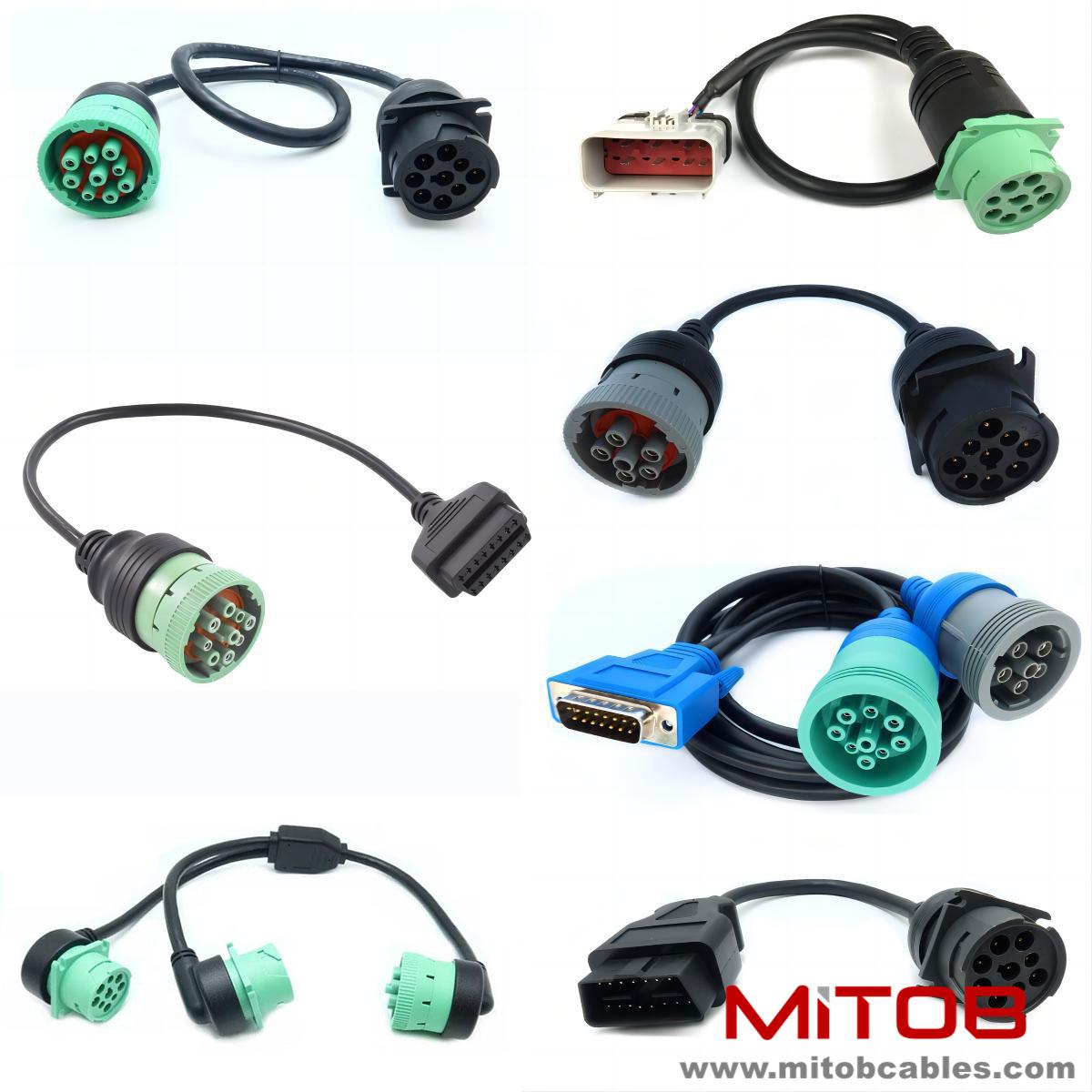
At the physical interface level, OBDII adopts a standardized 16 pin rectangular interface, which is a universal interface for passenger cars; J1939 mainstream heavy-duty vehicles mainly use 9-pin connectors, with pin definitions focusing on commercial vehicle CAN bus transmission. There is no unified 16 pin layout, and the physical structure is completely mismatched, making it impossible to directly plug and dock.
At the protocol standard level, OBDII is a diagnostic protocol for emission monitoring, following the ISO 15031 standard. The data transmission rate and message format are designed specifically for passenger cars, and only support basic fault codes and general operating condition data; J1939 is a commercial vehicle specific communication protocol based on CAN 2.0B, following the SAE J1939 standard. It has a higher transmission rate, more complex message ID and data field definitions, and can transmit engine, gearbox ABS、 The data of the entire onboard electronic control system, including instruments, covers exclusive parameters for heavy-duty vehicles, and the two protocols cannot be directly interconnected.
At the application scenario and functional level, OBDII focuses on passenger car exhaust compliance testing and routine troubleshooting; J1939 focuses on commercial vehicle fleet management, heavy equipment debugging, and deep maintenance of power systems, with significant differences in applicable vehicle models and functional requirements. The J1939 to OBDII cable not only completes physical interface conversion, but also has a built-in signal conversion module to achieve protocol adaptation and bus signal level matching, ensuring that diagnostic equipment can correctly parse commercial vehicle data and protect the vehicle ECU from voltage fluctuations.
In summary, both are incompatible in terms of hardware and software. The J1939 to OBDII cable is the only convenient solution for achieving cross protocol and cross interface communication, and it is also the core carrier for the universalization of commercial vehicle diagnostic equipment. Without it, conventional OBD equipment cannot be used to repair heavy vehicles.
Contact: Kevin
Phone: 0086-18823374992
E-mail: kevin@mitobcable.com
Whatsapp:
Add: Bld B2, Floor7 , Xinghe Zhongkai AI Industrial Park, Zhongkai High-tech Zone, Huizhou,China